5 sites that breakdown data on South Asians
As a South Asian woman who grew up in the Inland Empire – a suburban community in Southern California, I was exposed to very few other South Asians growing up. It was only when I arrived at the University of California, Berkeley that I became aware of the significant amount of Indians, Pakistanis, Bangladeshi students on campus, and also enamored with the South Asian clubs and associations.
My understanding of the world before then was limited simply by a lack of connection and awareness about other Desi communities. As an adult, I now work on providing data that illustrates the variety of challenges that various communities – including South Asians face around immigration, job access, housing burden, and more.
Here are a few tools that I have found useful in understanding the varying needs of the South Asians in my community in the US, and others around the world.
1) AAPI Data

AAPI Data is a nationally recognized publisher of demographic data and policy research on Asian Americans and Pacific Islanders, with hundreds of news mentions in national and local outlets. It was originally founded by Dr. Karthick Ramakrishnan associate dean of the UC Riverside School of Public Policy, and professor of public policy and political science. The site is used by journalists, community organizations, government agencies, and decision-makers to better understand key aspects of AAPI communities.
2) National Equity Atlas

The National Equity Atlas is a first-of-its-kind data and policy tool for the community leaders and policymakers who are working to build a new economy that is equitable, resilient, and prosperous. It is a comprehensive resource for data to track, measure, and make the case for racial equity and inclusive prosperity in America’s regions, and states, and nationwide. The Atlas contains data on demographic change, racial and economic inclusion, and the potential economic gains from racial equity for the largest 100 cities, largest 150 regions, all 50 states, and the United States as a whole.
3) The SHRUG
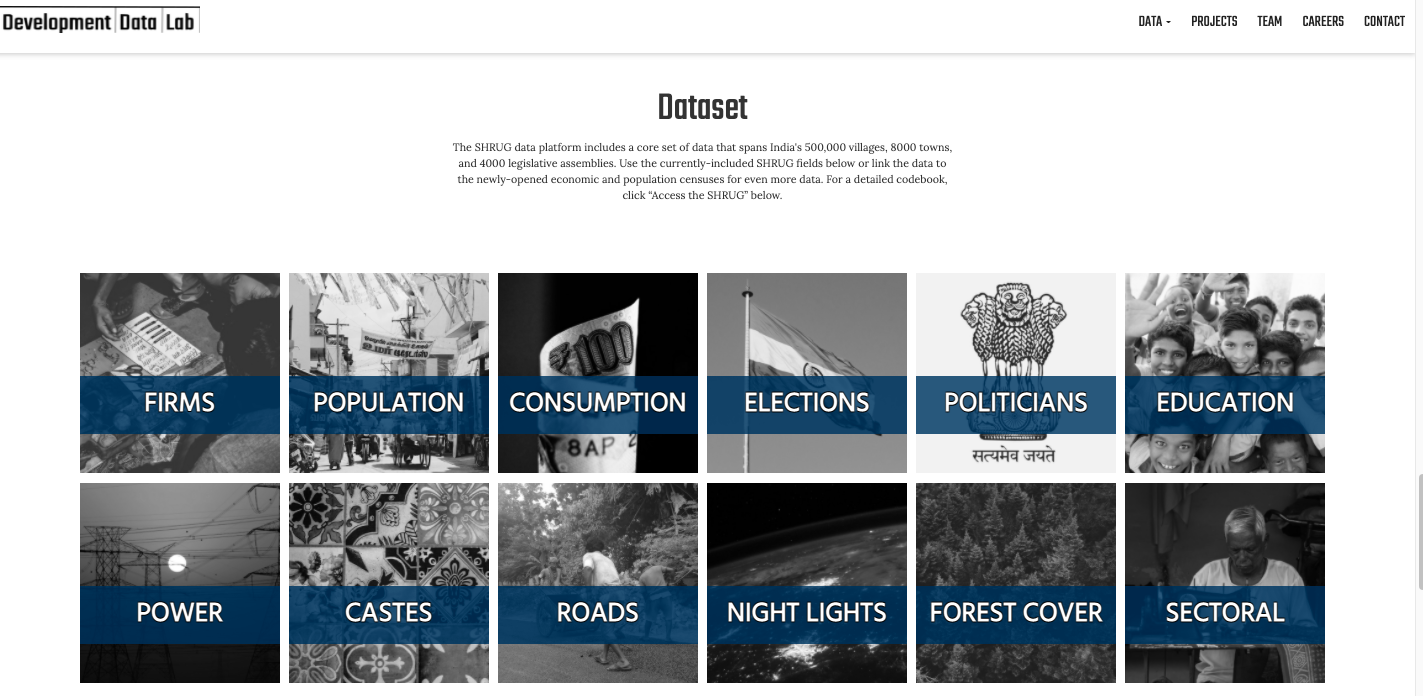
The Socioeconomic High-resolution Rural-Urban Geographic Platform for India (SHRUG) is a geographic platform that helps researchers working in India share data. It is an open access repository currently comprising dozens of datasets covering India’s 500,000 villages and 8000 towns using a set of common geographic identifiers that span 25 years.
Prior to the SHRUG, linking different Indian datasets has been a major burden for researchers. The common geographic frame of SHRUG makes it easy for researchers to share information and link to each others’ data.
4) CERP Labs
The Centre for Economic Research in Pakistan, or CERP, is an independent non-partisan policy institution focused on improving decision-making in Pakistan through rigorous quantitative research, engaging with policy counterparts with real policy challenges, and designing and advising on high-impact reforms based on data. The site has several projects which collect and provide data on various social issues in Pakistan.
5) UN Data

UNdata is a web-based data service for the global user community. It brings international statistical databases within easy reach of users through a single-entry point. Users can search and download a variety of statistical resources compiled by the United Nations (UN) statistical system and other international agencies. The numerous databases or tables are collectively known as “datamarts” contain over 60 million data points and cover a wide range of statistical themes including agriculture, crime, communication, development assistance, education, energy, environment, finance, gender, health, labor market, manufacturing, national accounts, population and migration, science and technology, tourism, transport, and trade.
If you have any of your own useful sites you would like to share, please let us know.